Who Defended a Medieval Castle When the Lord Was Away?
Were medieval women always waiting in towers to be rescued?Not quite.
Sometimes they were the ones making sure the castle didn't fall.
When we picture medieval castles, it's often the men we imagine defending the walls while the women wait safely inside.
The reality could be very different.
When a husband was away fighting, imprisoned, or had died, responsibility for the castle could fall to his wife. Suddenly she wasn't simply looking after her family—she was responsible for everyone living within the castle walls.
Its people.
Its food.
Its defences.
Its future.
These women weren't trying to become warriors. They were simply doing whatever they had to do to keep their families, households and communities safe.
More Than a Lady of the Castle
Defending a castle didn't necessarily mean standing on the battlements with a sword.
A noblewoman might instead:
- Organise food and water supplies.
- Command the garrison.
- Supervise repairs to the walls and gates.
- Direct the castle's archers.
- Negotiate with attackers.
- Keep order among the people sheltering inside.
Leadership could be just as important as fighting.
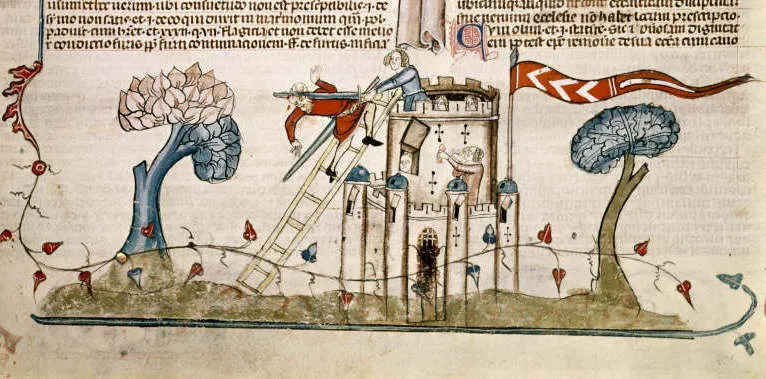
What Does This Manuscript Show?
Take a closer look at this medieval illustration.
At first glance, you might simply see a woman standing on the battlements defending her castle.
But look again.
She is wielding a sword against an attacker climbing a ladder to the castle walls.
Is this a real historical event? Probably not. The illustration accompanies a legal manuscript rather than a chronicle.
What it does show, however, is that medieval artists—and their audiences—were perfectly familiar with the idea that a woman might defend a castle when circumstances demanded it.
Women Who Really Defended Castles
History gives us several remarkable examples.
One of the best known is Matilda de Braose (c.1155–1210), who defended Painscastle during a Welsh siege in 1198 while her husband was absent.
Another is Nicola de la Haye (c.1150–1230), castellan of Lincoln Castle, who successfully organised its defence during the First Barons' War (1215–1217). Her determination earned the trust of King John, who confirmed her as hereditary castellan of Lincoln Castle, securing her place as one of medieval England's most remarkable women.
These women remind us that leadership wasn't always about charging into battle. Sometimes it meant making difficult decisions, keeping people alive and refusing to surrender.
Why This Story Matters to Me
One of the reasons this period has always fascinated me is that it has inspired some wonderful historical fiction. Barbara Erskine's Lady of Hay introduced me to Matilda de Braose and the Welsh Marches many years ago. While it's a novel rather than a history book, it captures the atmosphere of the border castles so beautifully that it was one of the books that made me fall in love with this part of medieval history.
Sources
- British Library. Smithfield Decretals (Royal MS 10 E IV), England (London?), c.1340. Manuscript illumination showing a woman defending a castle. Image accessed via Wikimedia Commons.
- Pamela D. Toler, "From the Archives: A Woman's Home is Her Castle", History in the Margins, 12 January 2023.
Further Reading
- Barbara Erskine, Lady of Hay. Historical fiction that first introduced me to Matilda de Braose and the Welsh Marches.