Latest Article
-
Medieval Shopping Wasn't Quite Like Amazon
Your medieval delivery was finally here. Unfortunately, it had taken six weeks and arrived by donkey.
We tend to think of shopping as a fairly modern activity. You find what you want, click a button, hand over some money and wait for the familiar “Your order has shipped” email.
So where did medieval people shop?
For most people, the local market was an important part of everyday life.
Markets brought together people selling food, livestock, cloth, tools and other goods. Depending on where you lived, you might also encounter specialist craftsmen selling things they had made themselves.
A market wasn't simply a place to buy things. It was also a place to meet people, exchange news and conduct business.
And unlike a modern supermarket, you couldn't simply wander around filling a basket while carefully avoiding eye contact with the cashier.
You had to deal with actual people.
And sometimes you had to negotiate
One particularly useful skill was knowing what something was worth.
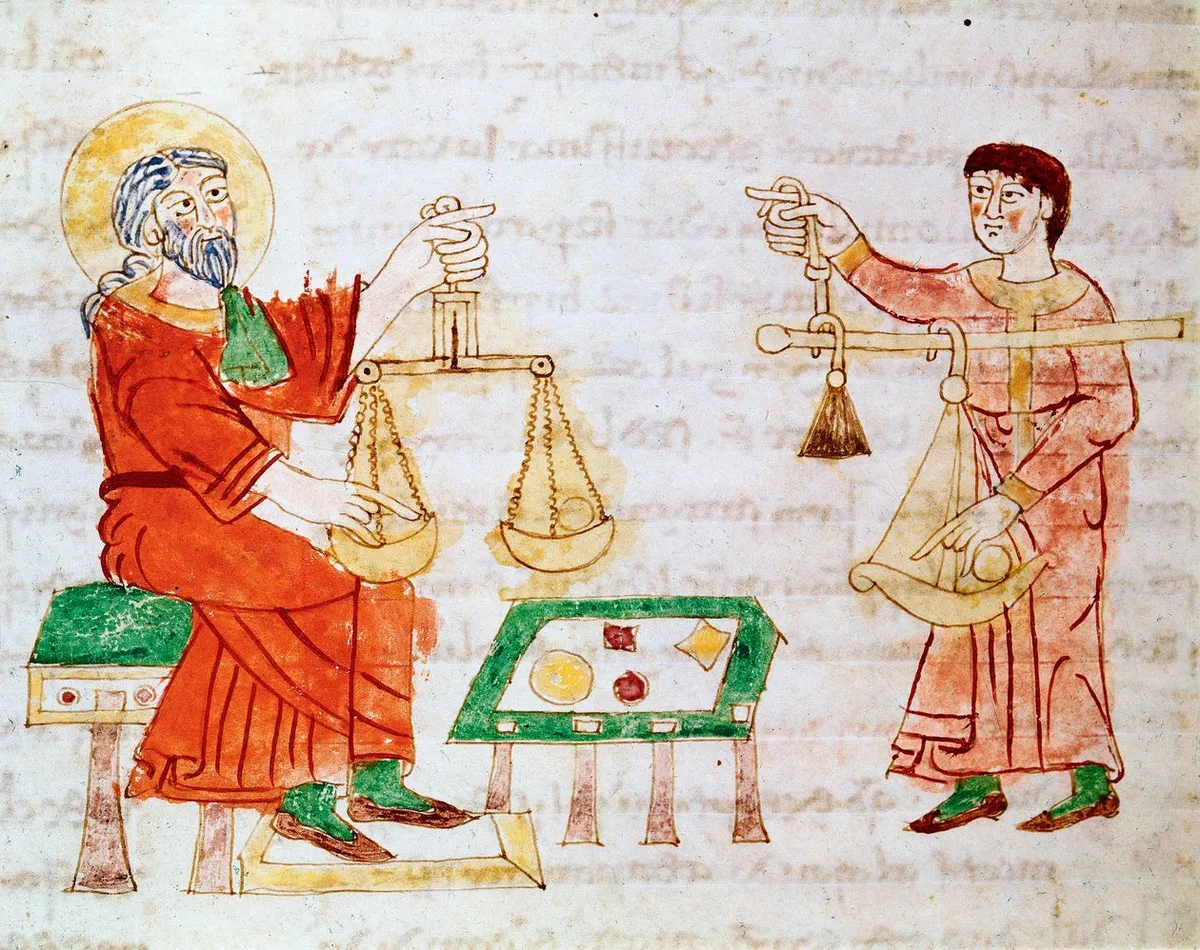
Merchants using scales to weigh and bargain, from De Universo (De rerum naturis), Monte Cassino MS Casin 132, c. 1022–1035. Unknown artist. Public domain. Weights and measures were an important part of medieval trade. The precise systems varied between places and periods, which could make buying and selling rather more complicated than simply looking at a price tag.
And you had to trust that you were getting what you'd paid for. Not everyone was necessarily as honest as they might have been.
It seems the art of getting a bargain — or being thoroughly fleeced — is nothing new.
Explore
-
Medieval Shopping Wasn't Quite Like Amazon
Your medieval delivery was finally here. Unfortunately, it had taken six weeks and arrived by donkey.
We tend to think of shopping as a fairly modern activity. You find what you want, click a button, hand over some money and wait for the familiar “Your order has shipped” email.
So where did medieval people shop?
For most people, the local market was an important part of everyday life.
Markets brought together people selling food, livestock, cloth, tools and other goods. Depending on where you lived, you might also encounter specialist craftsmen selling things they had made themselves.
A market wasn't simply a place to buy things. It was also a place to meet people, exchange news and conduct business.
And unlike a modern supermarket, you couldn't simply wander around filling a basket while carefully avoiding eye contact with the cashier.
You had to deal with actual people.
And sometimes you had to negotiate
One particularly useful skill was knowing what something was worth.
Merchants using scales to weigh and bargain, from De Universo (De rerum naturis), Monte Cassino MS Casin 132, c. 1022–1035. Unknown artist. Public domain. Weights and measures were an important part of medieval trade. The precise systems varied between places and periods, which could make buying and selling rather more complicated than simply looking at a price tag.
And you had to trust that you were getting what you'd paid for. Not everyone was necessarily as honest as they might have been.
It seems the art of getting a bargain — or being thoroughly fleeced — is nothing new.
-
Eel Currency: Or, How England Paid Its Bills With Fish
In 1238, the monks of Ramsey Abbey were paying their rent in 1,000 eels.
Not metaphorically.
Actual eels.
They also owed two pounds of pepper, two pounds of spice, and a pair of scarlet hose.
All of it was part of an agreement concerning a road across low-lying land near St Ives.
It sounds like someone has invented the strangest medieval shopping list imaginable.
They hadn't.
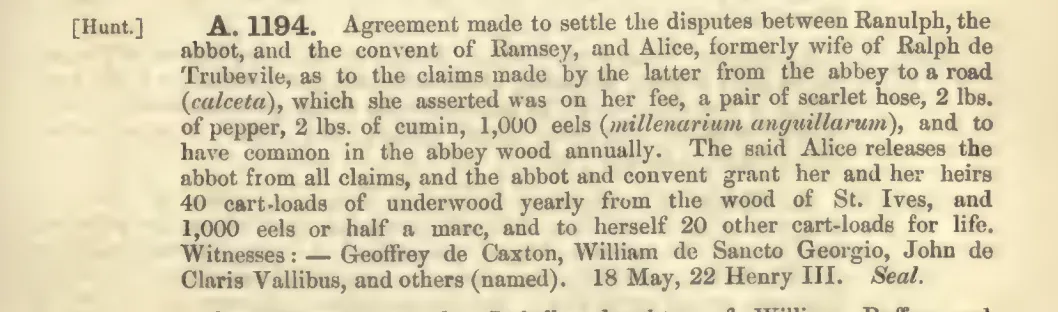
Record of the agreement between Ranulph, abbot of Ramsey, and Alice, formerly wife of Ralph de Trubevile, concerning the road, annual payments and common rights. A Descriptive Catalogue of Ancient Deeds in the Public Record Office, Vol. I, A.1194, 18 May, 22 Henry III (1238). Public domain. The arrangement was already an old one by this point.
Alice, the widow of Ralph de Trubevile, claimed rights connected with the road, the annual payment and common rights in the abbey wood.
So in 1238, she and the abbot of Ramsey settled the dispute.
And the new deal was even stranger.
She would receive 40 cartloads of underwood every year, 1,000 eels — or half a mark instead — and another 20 cartloads of wood for the rest of her life.
The scarlet hose disappeared.
The eels stayed.
Eel Rent Wasn't As Strange As It Sounds
And this wasn't some bizarre one-off.
By the time of the Domesday survey in 1086, eel rents were being recorded across England. More than 400,000 eels are recorded in the Domesday material, with the total rising to almost 540,000 when additional surviving charters are included.
Some of the individual payments were enormous.
At Harmston in Lincolnshire, the annual rent was 75,000 eels.
Seventy-five thousand.
In eels.
So why were people paying their rent with fish?
Because in some places, eels were plentiful, valuable and surprisingly practical.
They could be caught in large numbers, preserved and stored. In an economy where not every transaction involved coins, a quantity of eels was a perfectly useful thing to owe someone.
They were food.
They were valuable.
And, apparently, they were rent.
Which makes the Ramsey agreement particularly brilliant.
Someone needed to use a road.
Someone else had rights over the land.
They argued about it.
They negotiated.
And eventually they wrote down the solution.
1,000 eels.
Plus spices.
Plus scarlet hose.
Until eventually the hose disappeared and the eels remained.
Harmston, meanwhile, was still dealing in 75,000 of the things.
Medieval England really did have eel rent.
Sources
- H. C. Maxwell Lyte (ed.), A Descriptive Catalogue of Ancient Deeds in the Public Record Office, Vol. I (1890), A.1194. The entry records the agreement between Ranulph, abbot of Ramsey, and Alice, formerly wife of Ralph de Trubevile, dated 18 May, 22 Henry III (1238). Digitised scan via the Internet Archive.
- Victoria County History: Huntingdonshire, Vol. II, pp. 309–314. The history of Hemingford Grey describes the causeway and the earlier annual payment of 1,000 eels, pepper, ginger and scarlet hose, with the arrangement altered in 1238.
- John Wyatt Greenlee, “Seeing All the Anguilles.” The research calculates 403,760 eels in the Domesday records and 539,785 when additional surviving charters are included.
-
How Do We Know What Medieval Life Really Looked Like?
What do a medical handbook, two prayer books and a book of Church law have in common?
Surprisingly, they are some of the greatest windows into everyday life in the Middle Ages.
When people imagine medieval manuscripts, they often picture pages filled with Latin writing, saints and gold leaf. While those things certainly exist, many manuscripts contain something far more unexpected: ordinary people going about their daily lives.
Farmers harvesting crops. Shepherds tending sheep. Women spinning wool. Bakers making bread. Kings fighting battles. These scenes were never intended to be historical records, yet today they provide some of the richest visual evidence we have for understanding life in medieval Europe.
Four remarkable manuscripts in particular have become invaluable to historians. Although each was created for a different purpose, together they preserve an extraordinary glimpse into the lives of ordinary medieval people.
Tacuinum Sanitatis
The Tacuinum Sanitatis began life as a medical handbook written in eleventh-century Baghdad by the physician Ibn Butlan. It explained how food, exercise, sleep and the changing seasons affected health. During the late fourteenth century, wealthy patrons in northern Italy commissioned lavishly illustrated copies, transforming a practical guide into one of the finest visual records of medieval daily life.
Its pages show gardeners, farmers, cooks, merchants and labourers alongside the fruits, vegetables and animals that shaped medieval diets.

Cabbages being harvested, illustrated in the 14th-century Tacuinum Sanitatis. Luttrell Psalter
Created in England between about 1325 and 1340 for Sir Geoffrey Luttrell, the Luttrell Psalter is a beautifully illuminated book of Psalms. While intended for private devotion, its illustrations provide an extraordinary glimpse into medieval English rural life.
Ploughmen work the fields, shepherds tend their flocks, labourers harvest crops and villagers go about their daily lives. Few surviving manuscripts capture the rhythms of medieval England with such warmth and detail.
.png)
Sheep gathered in a medieval sheep pen, illustrated in the Luttrell Psalter. Queen Mary Psalter
Produced in England around 1310–1320, the Queen Mary Psalter is one of the greatest illuminated manuscripts of the Middle Ages. Alongside biblical stories are hundreds of illustrations depicting hunting, animals, historical events and scenes from everyday life.
One striking image shows King Oswald of Northumbria fighting King Penda of Mercia at the Battle of Maserfield in AD 642, demonstrating how medieval artists also recorded important moments from England's past.

Oswald of Northumbria fighting Penda of Mercia at the Battle of Maserfield, illustrated in the Queen Mary Psalter. Smithfield Decretals
The Smithfield Decretals are perhaps the most unexpected of all. Although the text itself is a collection of medieval Church law, the margins are filled with lively and often humorous illustrations that reveal the personalities and everyday experiences of medieval people.
Among its many delightful scenes is an affectionate encounter between a man and a woman at her spinning wheel, reminding us that medieval manuscripts could capture moments of humour, affection and ordinary human life alongside their more serious purpose.
_(c.1340),_f.139_-_BL_Royal_MS_10_E_IV.jpg)
An amorous encounter, illustrated in the Smithfield Decretals (c. 1340). Why These Manuscripts Matter
None of these manuscripts were created to document everyday life. Yet together they preserve an extraordinary record of farming, food, clothing, work, relationships and even historical events. They allow us to glimpse the lives of people whose stories are rarely recorded in written documents.
For historians, these manuscripts are far more than beautiful works of art. They are windows into a world that disappeared centuries ago, helping us understand not only medieval kings and nobles, but also the farmers, shepherds, craftsmen, women and families who shaped life in the Middle Ages.
Image Credits
- Tacuinum Sanitatis. Österreichische Nationalbibliothek, Cod. Vind. Ser. n. 2644. Public domain.
- Luttrell Psalter. British Library, Add MS 42130, f. 163v. Public domain.
- Queen Mary Psalter. British Library, Royal MS 2 B VII. Public domain.
- Smithfield Decretals. British Library, Royal MS 10 E IV, f. 139. CC0 1.0 Universal Public Domain Dedication.
Sources & Further Reading
- British Library Digital Collections.
- Österreichische Nationalbibliothek Digital Collections.
- Wikimedia Commons (image access and licensing).
-
The Sanctuary Knocker — Or, How To Make A Church Everyone's Problem For Forty Days
Imagine you've just committed a crime in medieval England.
The sheriff is behind you. Half the village is shouting. Someone has probably brought a stick.
Your best chance isn't to run faster.
It's The nearest church door, obviously.
For centuries, English churches offered sanctuary to fugitives. Claim it, and the authorities couldn't simply drag you away.
That second option, known as abjuring the realm, meant giving up your possessions and heading for a designated port, traditionally carrying a wooden cross.

Hubert de Burgh seeking sanctuary at Merton Priory after fleeing royal officials. Matthew Paris's Historia Anglorum (13th century). British Library, Royal MS 14 C VII, f. 119. Even powerful men needed sanctuary. In 1232, Hubert de Burgh, once one of England's most powerful royal officials, fled to Merton Priory after falling from royal favour.
Sanctuary offered protection, not permanent escape. Eventually, you had to face the consequences or leave the country.
Still, if the sheriff was behind you and half the village was shouting, that church door must have looked rather inviting.
Sources
- Primary Source: Matthew Paris, Historia Anglorum, British Library, Royal MS 14 C VII, f. 119.
- Image: Wikimedia Commons (British Library).
-
The Medieval Pinfold
I walk the same route through my village most days.
Recently, I noticed a small fenced stone enclosure beside the village pub that I'd somehow never paid much attention to before.
A nearby sign explained what it was.
A medieval pinfold.
Until that moment, I'd never really thought about where medieval villagers put stray animals.
It turns out they had a solution.
Enclosures like this were known as pinfolds (or village pounds) — small walled pens where wandering livestock were kept until their owners came to collect them.
If your sheep, cow, pig or even your goose decided to explore someone else's field, graze on the lord's crops, or simply disappear down the lane, the animal could be rounded up and placed in the pinfold.
Getting it back usually involved paying a small fee to the person responsible for looking after the enclosure.
More Than Somewhere to Keep Sheep
This wasn't simply a convenient place to park wandering livestock.
The medieval village depended upon animals, and stray animals could cause real damage. A loose pig rooting through crops or a neighbour's cow grazing in the wrong meadow could quickly become an expensive problem.
The pinfold provided a practical solution while also encouraging owners to keep a closer eye on their livestock.

Sheep enclosed within a woven hurdle pen. Medieval France, c. 1400. Bodleian Library, MS Douce 195. Available via Wikimedia Commons. Village Drama Included
As you might imagine, it wasn't always straightforward.
There were arguments over ownership. Disputes about whether an animal had really been trespassing. Complaints about the fees charged to recover it. And, in some places, penalties for breaking into the pinfold or releasing animals without permission.
Medieval law had a remarkable ability to turn even an escaped goose into official business.
Many Still Survive
Although livestock no longer wander through most English villages quite as freely, many old pinfolds still survive. Some have become gardens, some are protected historic features, and others — like the one I stumbled across on my daily walk — sit quietly beside village streets, their original purpose almost forgotten.
It's easy to walk past them without a second glance.
But seven hundred years ago, that little stone enclosure might have contained half the village's current argument.
The next time you pass an old pinfold, imagine it full of disgruntled geese, indignant pigs and one extremely apologetic villager trying to explain that his cow had absolutely no intention of eating the lord's cabbages.
Sources
- Bodleian Library, MS Douce 195. Sheep in a woven hurdle pen, France, c. 1400. Public domain, via Wikimedia Commons.
- Medieval village pinfolds (also known as village pounds) are discussed in manorial court records and local customs across medieval England.
-
When Insects Were Taken to Court
In medieval Europe, swarms of insects were sometimes put on trial for destroying crops.
Beetles, weevils, caterpillars and even rats could find themselves summoned before a court and ordered to leave the fields they were devastating.
It sounds ridiculous.
It also really happened.
_-_Der_naturen_bloeme_-_Jacob_van_Maerlant_-_KB_KA_16_-_131v_a1.jpg)
'Cinifes' (a kind of mosquito), from Der naturen bloeme (KB KA 16) by Jacob van Maerlant, c. 1340–1350. Medieval manuscripts often illustrated insects and other creatures that formed part of the natural world. Crop-destroying pests could threaten harvests and, in some parts of medieval Europe, even become the subject of legal proceedings. Putting Insects on Trial
From the thirteenth century onwards, communities in parts of France, Switzerland and northern Italy occasionally turned to the law when insects threatened their harvests.
This was not a criminal trial in the modern sense. Instead, church courts sometimes treated destructive swarms as a matter affecting both the community and the natural order established by God.
The insects were summoned collectively rather than individually. No one attempted to identify which particular beetle or caterpillar was responsible. The problem was simply that the pests were destroying the crops.
A Lawyer for the Beetles
Some cases became surprisingly elaborate.
Records survive of advocates being appointed to argue on behalf of the insects, claiming that they too were part of God's creation and therefore entitled to live and feed.
The judges, meanwhile, represented the interests of the farming community whose livelihood was under threat.
If no agreement could be reached, the insects might be ordered to leave the affected land within a specified period. If they ignored the judgement, they could even be formally excommunicated.
They rarely complied.
Why Do It At All?
The purpose was never really to convince beetles to obey a court order.
For medieval people, law, religion and the natural world were closely connected. A public legal process acknowledged that a disaster had occurred, demonstrated that every proper step had been taken, and placed the outcome in God's hands.
The paperwork was completed.
The prayers were said.
Order, at least in a legal and spiritual sense, had been restored.
Sources
- Jacob van Maerlant, Der naturen bloeme (KB KA 16), fol. 131v, "Cinifes", c. 1340–1350. Public domain via Wikimedia Commons.
-
What Happened When You Broke the Rules in a Medieval Village?
Medieval villages are often imagined as places where everyone obeyed the church, the lord, and the rules without question.
Reality?
People were human. Humans bend rules. Humans break rules.
Medieval England had plenty of ways of dealing with that.
Some punishments were practical.
Some were embarrassing.
Some were expensive.
And some were unmistakably medieval.Let's wander into the village and see what could happen.
Whose Rules Were You Breaking?
Life in a medieval village wasn't governed by one neat system. It was a web of overlapping authority:
- The Church
- The lord's manor court
- Royal law (for more serious offences)
- Local custom, which often mattered as much as written law
Everyone knew the expectations, even if they couldn't read them. Rules were spoken, remembered, repeated, enforced by neighbours... and often discussed at great length.
_Judge_cropped.jpg)
A judge, from a mid-13th-century manuscript of the Laws of Hywel Dda. The Manor Court: Where Everyday Trouble Went
Most village rule-breaking never reached a royal court.
Instead, it was dealt with in the manor court (often called the hallmote).
This wasn't a grand courtroom filled with lawyers.
It was usually held in a manor hall, barn or open meeting place, with:
- villagers attending as jurors or witnesses
- local officials presenting complaints
- the lord's steward presiding over proceedings
Imagine something between a parish meeting, a neighbourhood dispute, and an extremely nosy village gathering... with fines at the end.
People appeared before the court for things like:
- failing to maintain hedges or boundaries
- allowing animals to stray into neighbours' crops
- neglecting their feudal obligations
- selling ale that broke the Assize of Ale
- taking timber or firewood without permission
- assaults, quarrels or creating a nuisance
- failing to attend court when summoned
Punishment?
Most often... a fine.
Usually small, but enough to hurt if money was already tight.
One thing quickly becomes obvious when you read surviving manor court rolls:
People broke the rules again anyway.
Because sometimes they had little choice.
Shame Was a Powerful Punishment
Money wasn't the only way medieval communities enforced good behaviour.
Public embarrassment could be just as effective.
The aim wasn't always to cause pain.
It was to make sure everyone knew what had happened.
The Stocks
The stocks restrained a person's feet—or sometimes hands—in a public place where everyone could see them.
Neighbours might laugh.
Children might stare.
Some people probably offered less-than-kind opinions.
It wasn't simply about punishment.
It was about reputation.
The Pillory
The pillory worked on a similar principle but was usually reserved for more serious offences, particularly dishonest trading, cheating customers or market offences.
It sent a clear message:
This person has broken the community's trust.
That said, not every offender ended up in the stocks or pillory. For most everyday disputes, paying a fine was far more common.
When the Church Became Involved
Not every offence belonged in the manor court.
Church courts dealt with religious and moral matters.
Depending on the offence, punishments could include:
- public penance
- fines
- acts of repentance
- and, in more serious cases, excommunication
For medieval people, these penalties carried real weight.
Faith shaped everyday life, and concern for the soul was just as real as concern for the harvest.
Many "Crimes" Were Really About Survival
A surprising number of medieval offences weren't driven by greed.
They were driven by necessity.
Why might someone...
- take wood from the lord's woodland?
- graze animals where they shouldn't?
- sell ale without following local regulations?
- poach a rabbit?
Often because winter was cold.
Food was scarce.
Or money had simply run out.
Behind many offences lay the reality of surviving another season.
Medieval justice could be harsh.
But it existed in a world where resources were limited and every hedge, field and woodland boundary mattered.
Sometimes People Simply... Got Away With It
Villages were close-knit communities.
Everyone knew everyone else.
That meant:
- neighbours sometimes turned a blind eye
- disputes were settled quietly
- complaints often appeared only after tempers finally snapped
People lived alongside one another for decades.
You couldn't simply remove someone from the community.
You still had to see them at church, at market and during harvest.
Medieval villages constantly balanced order with practicality.
Rules mattered.
So did relationships.
Medieval people argued.
They bent the rules.
They annoyed their neighbours.
And, seven hundred years later, the surviving court rolls still preserve the wonderfully ordinary record of everyday village life.
So, What Happened If You Broke the Rules?
Usually...
- Someone noticed.
- You might be presented before the manor court.
- You were probably fined.
- In some cases, you might face public humiliation.
- Then life carried on.
Medieval England wasn't lawless.
But neither was it a place where every mistake ended in brutal punishment.
Like any community, it relied on a mixture of rules, reputation, common sense and compromise.
People argued.
People bent the rules.
People annoyed their neighbours.
And, seven hundred years later, the surviving court rolls still preserve the wonderfully ordinary record of everyday village life.
Sources
- Peniarth MS 28, fol. 4r, mid-13th century. National Library of Wales. CC0, via Wikimedia Commons.
-
Toothache In The Middle Ages
Because medieval people had toothache too
They had teeth that hurt, teeth that broke, teeth that became infected and teeth that eventually had to come out.
They also had some rather interesting ideas about why teeth hurt.
The tooth worm
One long-standing explanation for toothache was the tooth worm — a tiny creature believed to burrow into the tooth and cause pain.
And if you believed a worm was causing your toothache, you needed a way to get rid of it.
Some remedies involved herbs, oils, poultices, prayers and charms. One particularly memorable treatment involved burning henbane seeds beneath the patient's mouth. The smoke produced tiny worm-shaped strands of ash, which could be interpreted as the worms leaving the tooth.
Whether that actually removed anything is another matter.
But the idea makes a little more sense when you remember that medieval medicine was working with a very different understanding of how the body worked.
And when the tooth wouldn't stop hurting?
Sometimes the answer was simply:
Take it out.
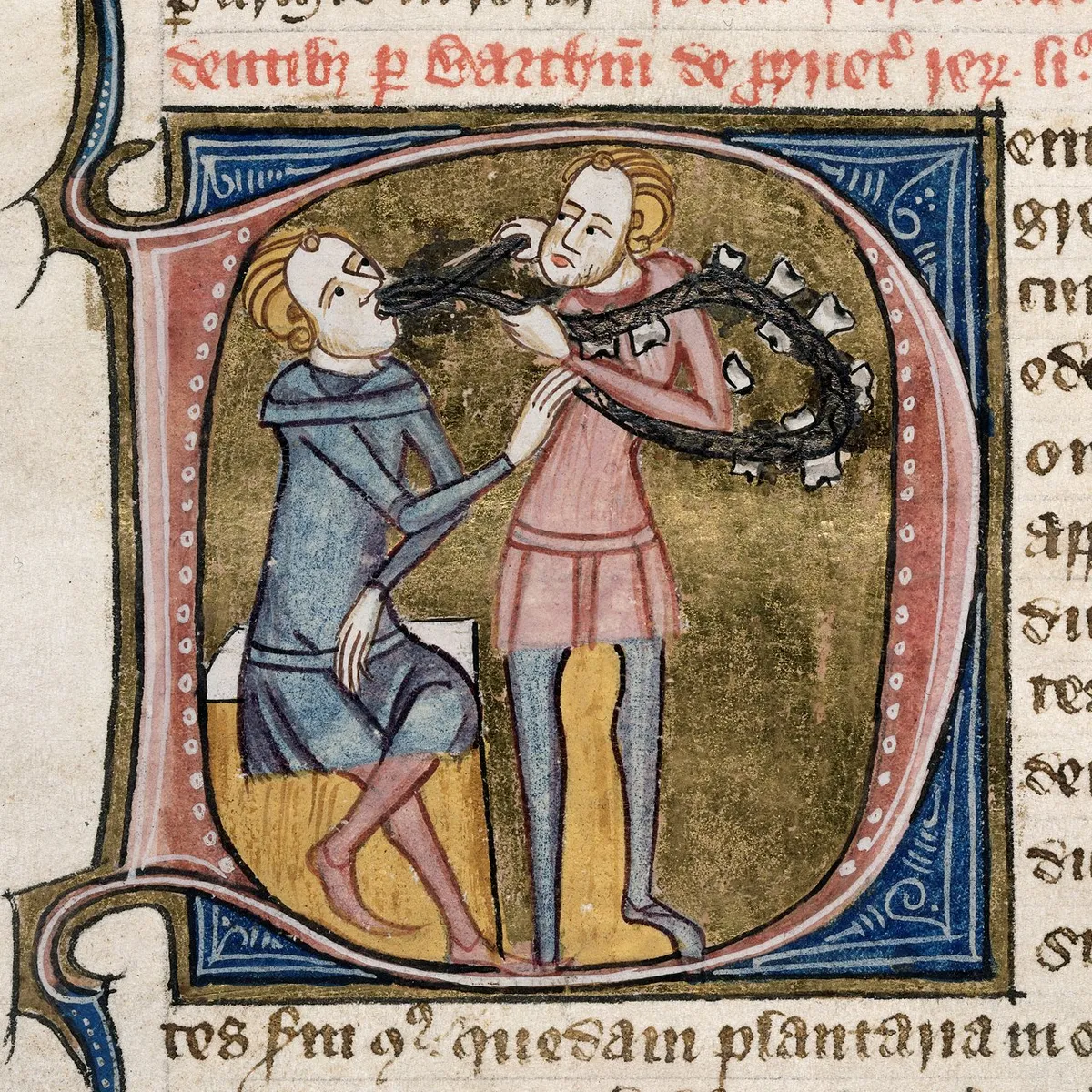
Medieval dentist extracting a tooth. The image above gives us a glimpse of that process.
There was no modern dental surgery. There was no anaesthetic as we know it today. The tools and techniques were very different.
And yet the basic problem is instantly recognisable.
That tooth hurts. Get the bloody thing out.
So the next time your dentist asks if you've been flossing, spare a thought for whoever was sitting in that medieval chair.
Because it could be worse.
They could be reaching for the forceps.
Source
British Library, Royal MS 6 E VI, f. 503v, Omne Bonum, James le Palmer, c. 1360–1375. Image via Wikimedia Commons. Public domain.
-
Meet The Medieval Citole
What on earth is that angel playing?
It looks a bit like a tiny medieval guitar.
It isn't.
It's a citole — a medieval stringed instrument that appears in manuscripts from the thirteenth and fourteenth centuries.
And once you know what you're looking at, you start seeing them everywhere.
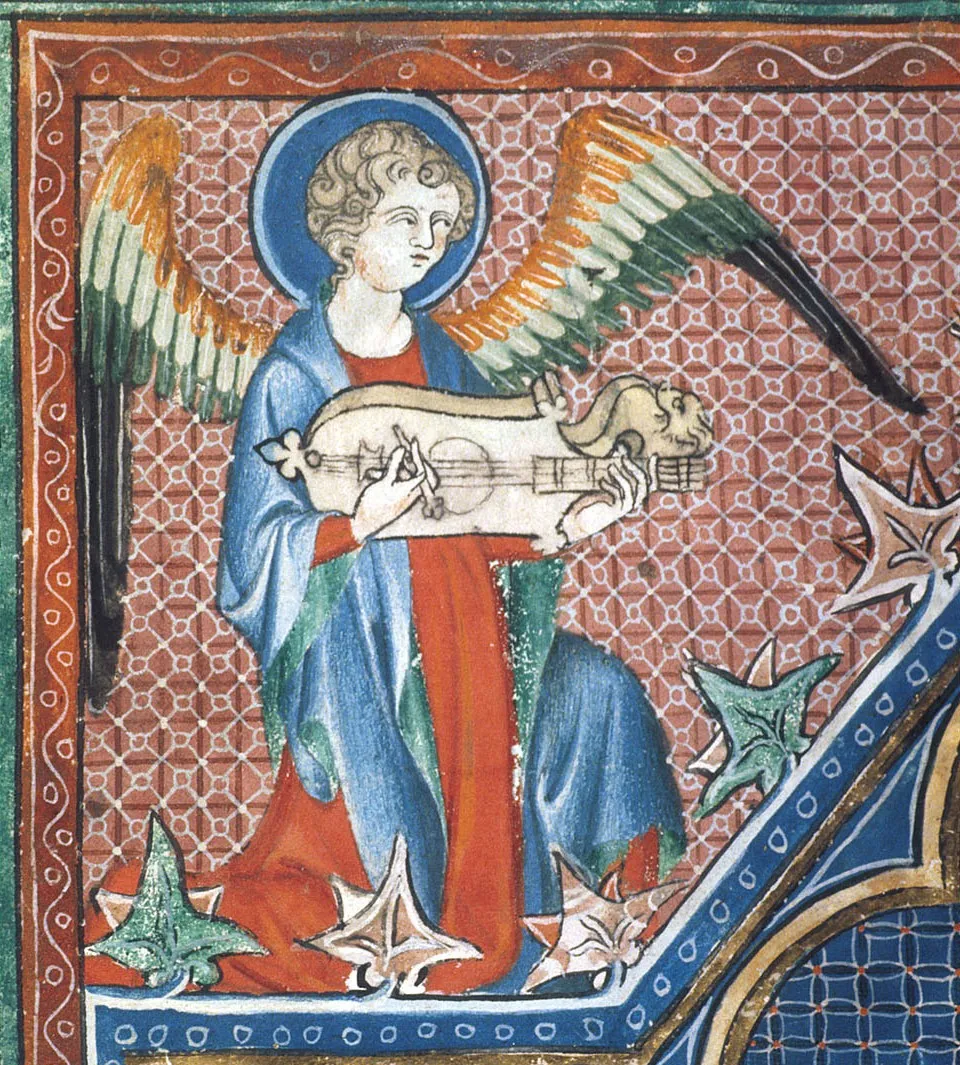
An angel playing a citole from the De Lisle Psalter, England, c. 1310 (British Library, Arundel MS 83, f. 134v). Public domain. This one appears in the De Lisle Psalter, made in England in the early fourteenth century. The angel is playing it with a plectrum, so this isn't simply some strange medieval artist's invention. The instrument was real.
We don't have a medieval recording, unfortunately. So we can't press play and hear what this particular angel sounded like.
But we do know that the citole was a musical instrument used in medieval Europe. It had strings, a wooden body and a shape that looks surprisingly familiar until you actually stop and look at it.
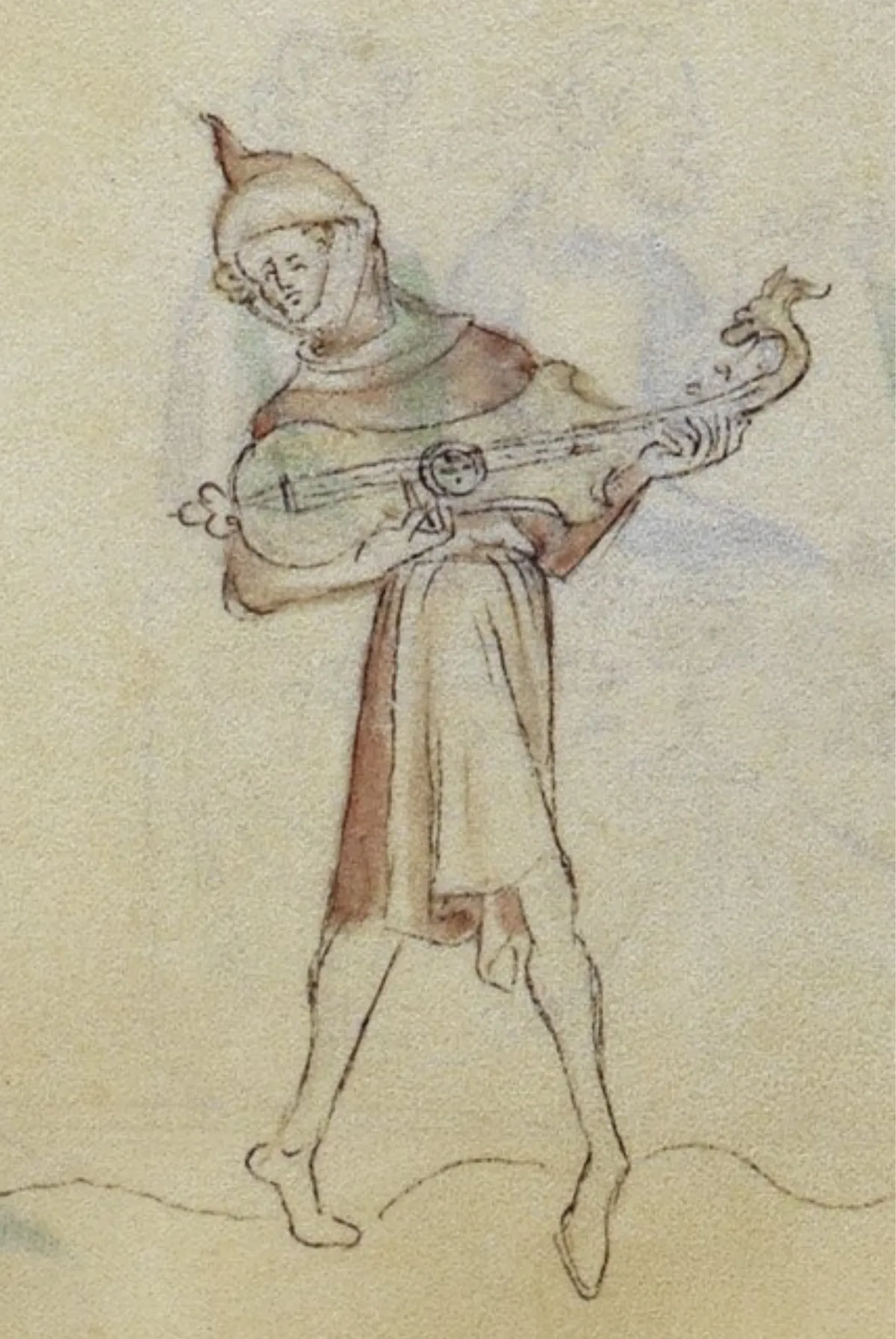
A musician playing a citole from the Queen Mary Psalter, England, c. 1310–1320. British Library. Public domain. By the later fourteenth century, the citole had become much less common, and its distinctive form gradually disappeared from medieval musical life.
Which is why most of us have never heard of one.
So there you have it: a 700-year-old musical instrument, hiding in plain sight in a medieval manuscript.
Sources & Image
Images:
- Angel playing a citole, De Lisle Psalter, England, c. 1310. British Library, Arundel MS 83, f. 134v. Public domain.
- Musician playing a citole, Queen Mary Psalter, England, c. 1310–1320. British Library, Royal MS 2 B VII. Public domain.
Further Reading:
- British Library, Arundel MS 83.
- Wikimedia Commons (image access and licensing).
-
Examining The Wine
Wait... is that how you bought wine in the Middle Ages?
There are no bottles on a shelf. No labels. No handy little price tags.
Instead, a customer is standing at a medieval wine stall, holding up a glass of red wine while the seller stands behind the counter.
He's looking at it.
Actually examining the wine before he buys it.
And suddenly something that feels very modern — choosing what you're going to drink — looks completely different.

A man examining a glass of red wine, from the Tacuinum Sanitatis, Casanatense MS 4182, 14th century. Biblioteca Casanatense, Rome. Public domain. We can't know from the image whether he was actually tasting the wine, or simply looking at it.
But we can see the interaction: wine being served, a customer examining it, and the everyday business of buying and selling taking place.
Sometimes one little picture is enough to give us a glimpse of medieval life.
Source
Tacuinum Sanitatis, Casanatense MS 4182, 14th century. Biblioteca Casanatense, Rome. Public domain.