What Happened When You Had Toothache in the Middle Ages?
Medieval people had teeth. They also had opinions about those teeth, remedies for those teeth, and a surprisingly confident explanation for why those teeth hurt.
Most of it was wrong. Some of it was accidentally effective. None of it was pleasant.
Daily Tooth Care (Such As It Was)
There were no toothbrushes and no toothpaste. People cleaned their teeth by rubbing them with a cloth, chewing fragrant herbs or sticks, or simply not cleaning them at all.
Wealthier households sometimes used tooth powders made from crushed herbs, charcoal, salt or ground shells. These were abrasive, often scented, and aimed more at freshening the breath than protecting the teeth.
Sugar was still expensive and uncommon, so medieval people generally had fewer cavities than you might expect. This wasn't because they understood dental health—it was largely because they ate far less refined sugar than we do today.
That didn't mean healthy mouths. Teeth wore down quickly from coarse bread that often contained tiny fragments of grit from millstones. Gums became infected. Abscesses appeared without warning, and once they did, there were very few good options.
The Tooth Worm
For centuries, toothache was commonly blamed on the tooth worm—a tiny creature believed to burrow into teeth and cause pain.
This wasn't a strange folk superstition on the fringes of society. It appeared in medical texts across Europe and remained an accepted explanation for dental pain for hundreds of years.
Treatments included holding hot herbs or oils in the mouth, applying poultices made from garlic, onion or vinegar, reciting prayers and charms, and, very often, simply waiting and hoping the pain would pass.
One particularly memorable remedy involved burning henbane seeds beneath the patient's mouth. The smoke produced tiny worm-shaped strands of ash, which were taken as proof that the worms were leaving the tooth.
Henbane also contains compounds with sedative effects, so the treatment may occasionally have eased the pain by accident.
It was not safe.
But it looked convincing, which was often enough.
When Waiting Didn't Work
Eventually, the tooth came out.
Extractions were carried out by barber-surgeons, travelling tooth-pullers, or anyone with strong hands, suitable tools, and enough confidence to have a go.
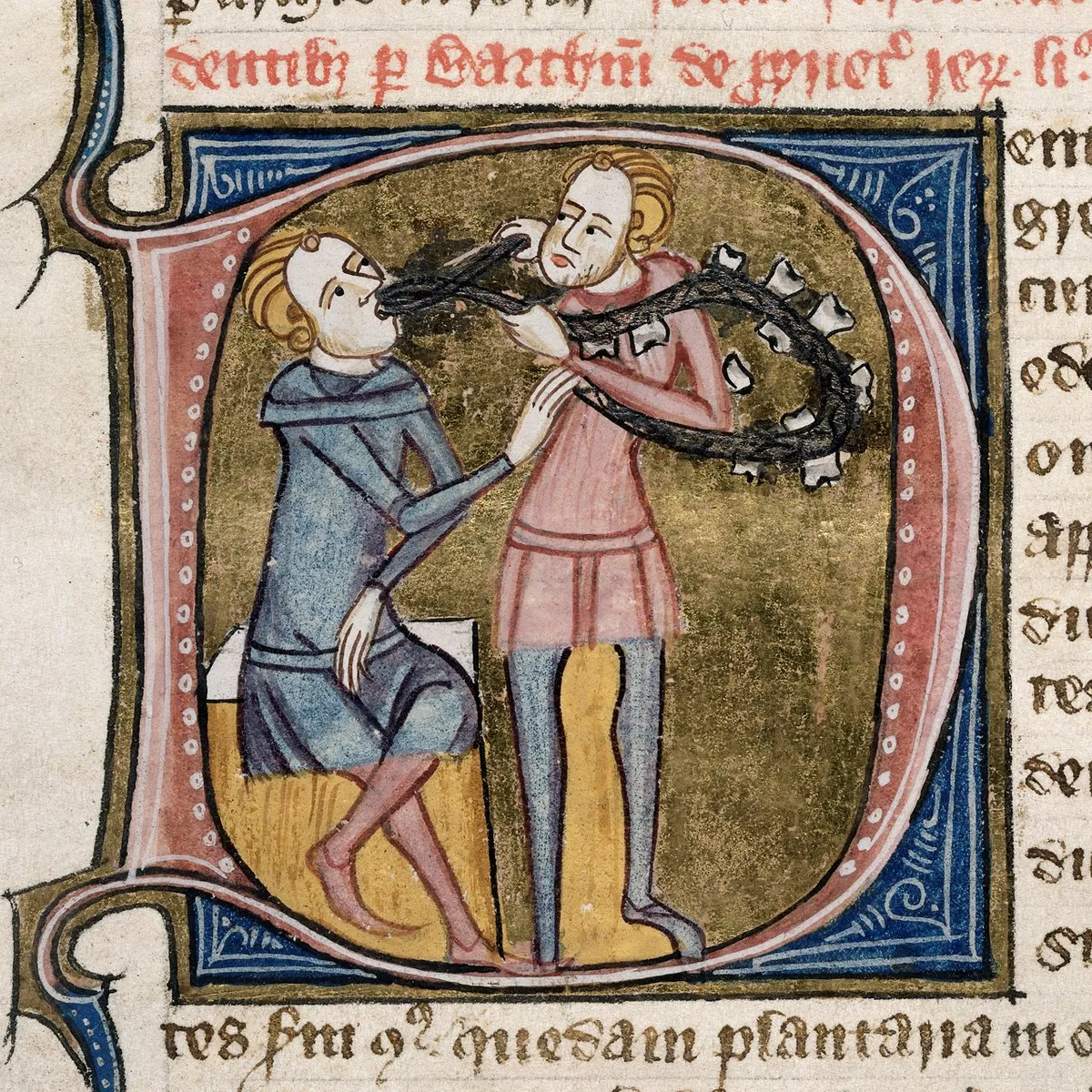
The miniature above shows a dentist using forceps to extract a patient's tooth. For those whose toothache refused to go away, this would have been a painfully familiar procedure.
Those tools included forceps, hooks, and sometimes little more than determined fingers.
There was no anaesthetic.
There might have been alcohol.
There was certainly prayer.
There was almost certainly screaming.
Afterwards
Bleeding was expected.
Infection was common.
If an infection spread into the jaw or throat, it could become life-threatening.
Many people simply learned to live with chronic tooth pain, quietly adapting everything around it—what they ate, how they slept, and even how they spoke.
The next time your dentist asks if you've been flossing, remember that it could be worse.
They could be reaching for the henbane.
Image Source
Image: A dentist extracting a tooth, historiated initial ‘D’ for dentes (teeth), from the Omne Bonum, compiled by James le Palmer, London, c.1360–1375. Royal MS 6 E VI, f.503v. British Library. Public Domain, via Wikimedia Commons.