The Rent Was 1,000 Eels. And a Pair of Scarlet Hose
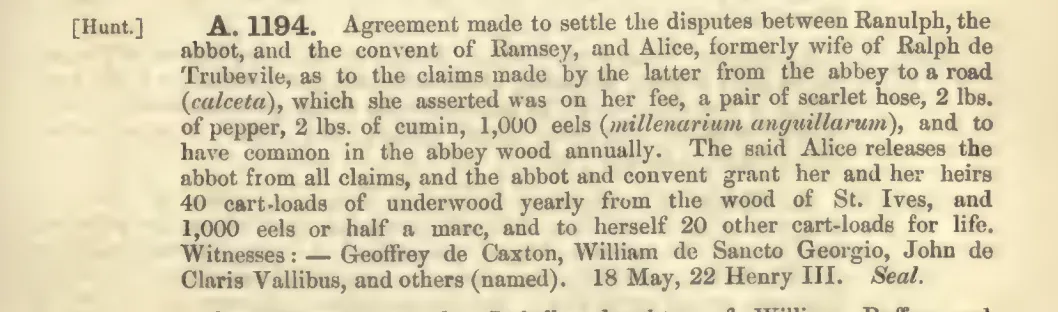
In 1238, the monks of Ramsey Abbey were paying their rent in 1,000 eels.
Not metaphorically.
Actual eels.
They also owed two pounds of pepper, two pounds of spice, and a pair of scarlet hose.
All of it was part of an agreement concerning a road across low-lying land near St Ives.
It sounds like someone has invented the strangest medieval shopping list imaginable.
They hadn't.
The arrangement was already an old one by this point.
Alice, the widow of Ralph de Trubevile, claimed rights connected with the road, the annual payment and common rights in the abbey wood.
So in 1238, she and the abbot of Ramsey settled the dispute.
And the new deal was even stranger.
She would receive 40 cartloads of underwood every year, 1,000 eels — or half a mark instead — and another 20 cartloads of wood for the rest of her life.
The scarlet hose disappeared.
The eels stayed.
And this wasn't some bizarre one-off.
By the time of the Domesday survey in 1086, eel rents were being recorded across England. More than 400,000 eels are recorded in the Domesday material, with the total rising to almost 540,000 when additional surviving charters are included.
Some of the individual payments were enormous.
At Harmston in Lincolnshire, the annual rent was 75,000 eels.
Seventy-five thousand.
In eels.
So why were people paying their rent with fish?
Because eels were plentiful, valuable and surprisingly practical.
They could be caught in large numbers, preserved and stored. In an economy where not every transaction involved coins, a quantity of eels was a perfectly useful thing to owe someone.
They were food.
They were valuable.
And, apparently, they were rent.
Which makes the Ramsey agreement particularly brilliant.
Someone needed to use a road.
Someone else had rights over the land.
They argued about it.
They negotiated.
And eventually they wrote down the solution.
1,000 eels.
Plus spices.
Plus scarlet hose.
Until eventually the hose disappeared and the eels remained.
Harmston, meanwhile, was still dealing in 75,000 of the things.
Medieval England really did have eel rent.
Sources
- H. C. Maxwell Lyte (ed.), A Descriptive Catalogue of Ancient Deeds in the Public Record Office, Vol. I (1890), A.1194. The entry records the agreement between Ranulph, abbot of Ramsey, and Alice, formerly wife of Ralph de Trubevile, dated 18 May, 22 Henry III (1238). Digitised scan via the Internet Archive.
- Victoria County History: Huntingdonshire, Vol. II, pp. 309–314. The history of Hemingford Grey describes the causeway and the earlier annual payment of 1,000 eels, pepper, ginger and scarlet hose, with the arrangement altered in 1238.
- John Wyatt Greenlee, “Seeing All the Anguilles.” The research calculates 403,760 eels in the Domesday records and 539,785 when additional surviving charters are included.