Someone Is Screaming in the Lane
Someone Is Screaming in the Street. You Have to Drop Everything and Run.
Doesn't matter what you're doing.
Doesn't matter if it's your problem.
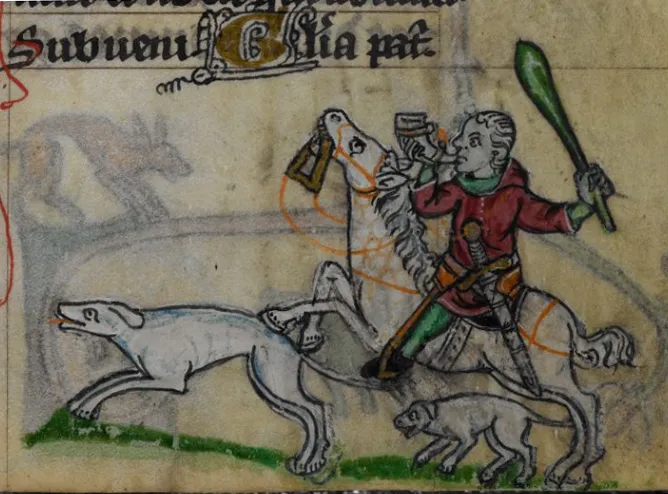
This is a mounted horn-blower, from the Maastricht Book of Hours, made in England around 1300–1325.
Horns like this one could be used to raise the alarm — and if the hue and cry reached you, you were expected to help.
You were expected to raise the alarm.
And then to help pursue the offender.
It didn't matter what you were doing.
Baking bread. Milking a cow. Mid-argument with your neighbour.
If the cry reached you, you could be expected to join the pursuit.
This was the Hue and Cry.
And it wasn't simply a polite request.
If you heard the alarm and just... carried on with your day, you could be fined.
So the safest thing to do was probably to start running — even if you had no idea who you were chasing, what they'd done, or quite how you had become involved.
Picture it.
A horn sounds.
A voice goes up somewhere near the mill.
And suddenly people are leaving whatever they're doing and heading after someone.
No police.
No CCTV.
Just a horn, a shout, and the very reasonable medieval assumption that if someone was in trouble, you were expected to do something about it.
Sources
- Maastricht Book of Hours, British Library, Stowe MS 17, f.126r, England, c.1300–1325.