Medieval Tooth Extractions
Someone Is Having Their Tooth Pulled. What on Earth?
Look what I found in a medieval manuscript.
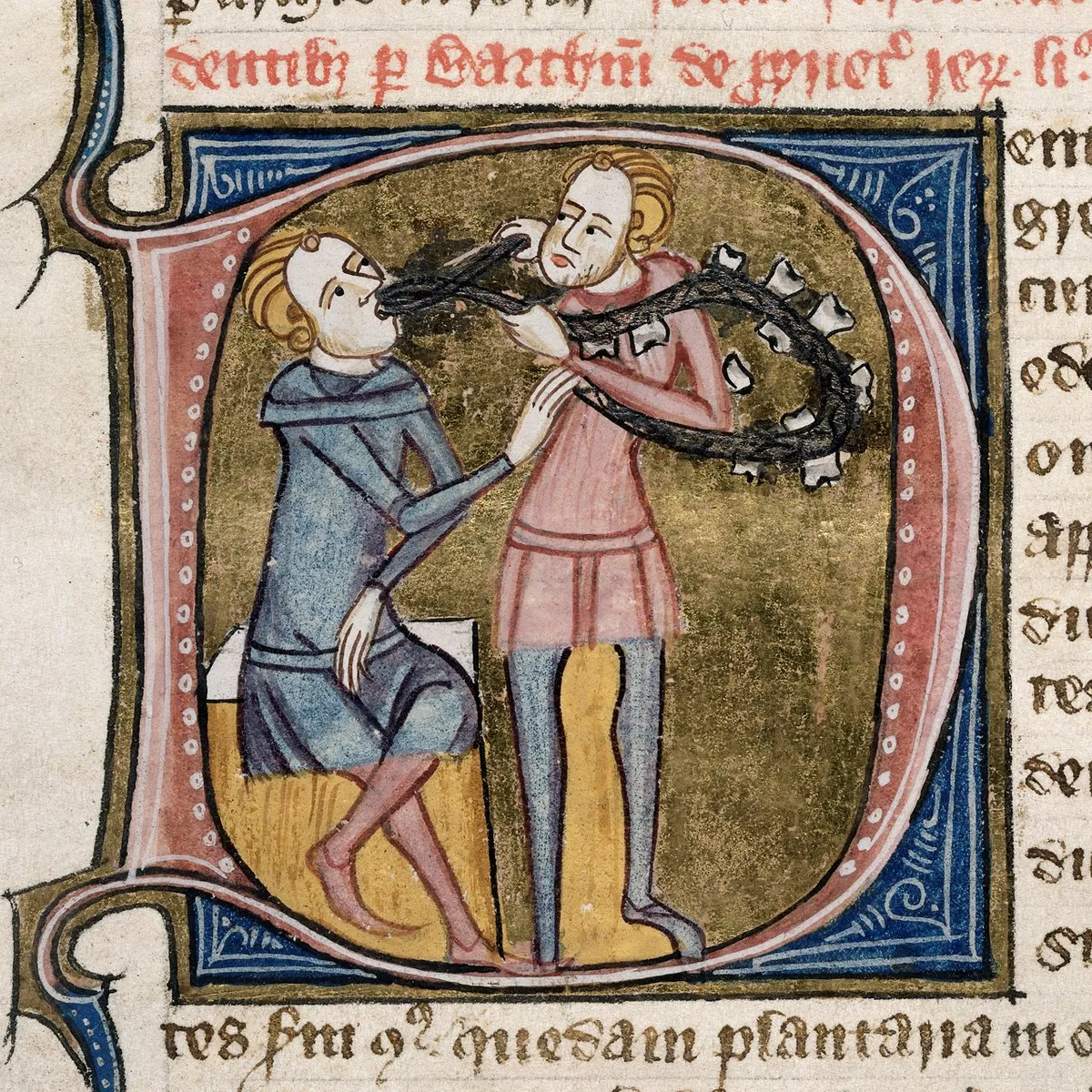
Wait. WHAT?
There it is, tucked into a medieval manuscript: a person having a tooth pulled while someone else appears to be doing the pulling.
It's a tiny picture, but it immediately raises a rather obvious question.
What was actually going on when your tooth hurt in the Middle Ages?
So what are we looking at?
This is a historiated initial ‘D’ for dentes (teeth) in the Omne Bonum, a huge encyclopaedic work compiled by James le Palmer in London around 1360–1375.
The image shows a dentist extracting a patient's tooth.
And suddenly this isn't just a strange little medieval picture.
It's a piece of evidence.
Because medieval people had toothache too.
They had teeth that hurt, teeth that broke, teeth that became infected and teeth that eventually had to come out.
They also had some rather interesting ideas about why teeth hurt.
The tooth worm
One long-standing explanation for toothache was the tooth worm — a tiny creature believed to burrow into the tooth and cause pain.
And if you believed a worm was causing your toothache, you needed a way to get rid of it.
Some remedies involved herbs, oils, poultices, prayers and charms. One particularly memorable treatment involved burning henbane seeds beneath the patient's mouth. The smoke produced tiny worm-shaped strands of ash, which could be interpreted as the worms leaving the tooth.
Whether that actually removed anything is another matter.
But the idea makes a little more sense when you remember that medieval medicine was working with a very different understanding of how the body worked.
And when the tooth wouldn't stop hurting?
Sometimes the answer was simply:
Take it out.
The image above gives us a glimpse of that process.
There was no modern dental surgery. There was no anaesthetic as we know it today. The tools and techniques were very different.
And yet the basic problem is instantly recognisable.
That tooth hurts. Get the bloody thing out.
And this is the bit I love.
We don't have to imagine what medieval dentistry looked like.
Someone actually drew it.
More than six hundred years later, we can still look at this tiny image and see a medieval dental procedure taking place.
We don't know everything about the person in the picture. We don't know who they were, what had happened to their tooth, or exactly how the procedure felt.
But we do have this.
A little piece of evidence, sitting inside a manuscript that has survived for centuries.
So the next time your dentist asks if you've been flossing, spare a thought for whoever was sitting in that medieval chair.
Because it could be worse.
They could be reaching for the forceps.
Image Source
Image: A dentist extracting a tooth, historiated initial ‘D’ for dentes (teeth), from the Omne Bonum, compiled by James le Palmer, London, c.1360–1375. Royal MS 6 E VI, f.503v. British Library. Public Domain, via Wikimedia Commons.