Medieval Shopping Wasn't Quite Like Amazon
Your medieval delivery was finally here. Unfortunately, it had taken six weeks and arrived by donkey.
We tend to think of shopping as a fairly modern activity. You find what you want, click a button, hand over some money and wait for the familiar “Your order has shipped” email.
Medieval people had none of that.
But they still needed to buy things.
Food, clothing, tools, household goods, animals, raw materials and all manner of other necessities had to be bought and sold. And while there was no online shopping, medieval commerce was actually rather sophisticated.
It just involved considerably more walking.
So where did medieval people shop?
For most people, the local market was an important part of everyday life.
Markets brought together people selling food, livestock, cloth, tools and other goods. Depending on where you lived, you might also encounter specialist craftsmen selling things they had made themselves.
A market wasn't simply a place to buy things. It was also a place to meet people, exchange news and conduct business.
And unlike a modern supermarket, you couldn't simply wander around filling a basket while carefully avoiding eye contact with the cashier.
You had to deal with actual people.
And sometimes you had to negotiate
One particularly useful skill was knowing what something was worth.
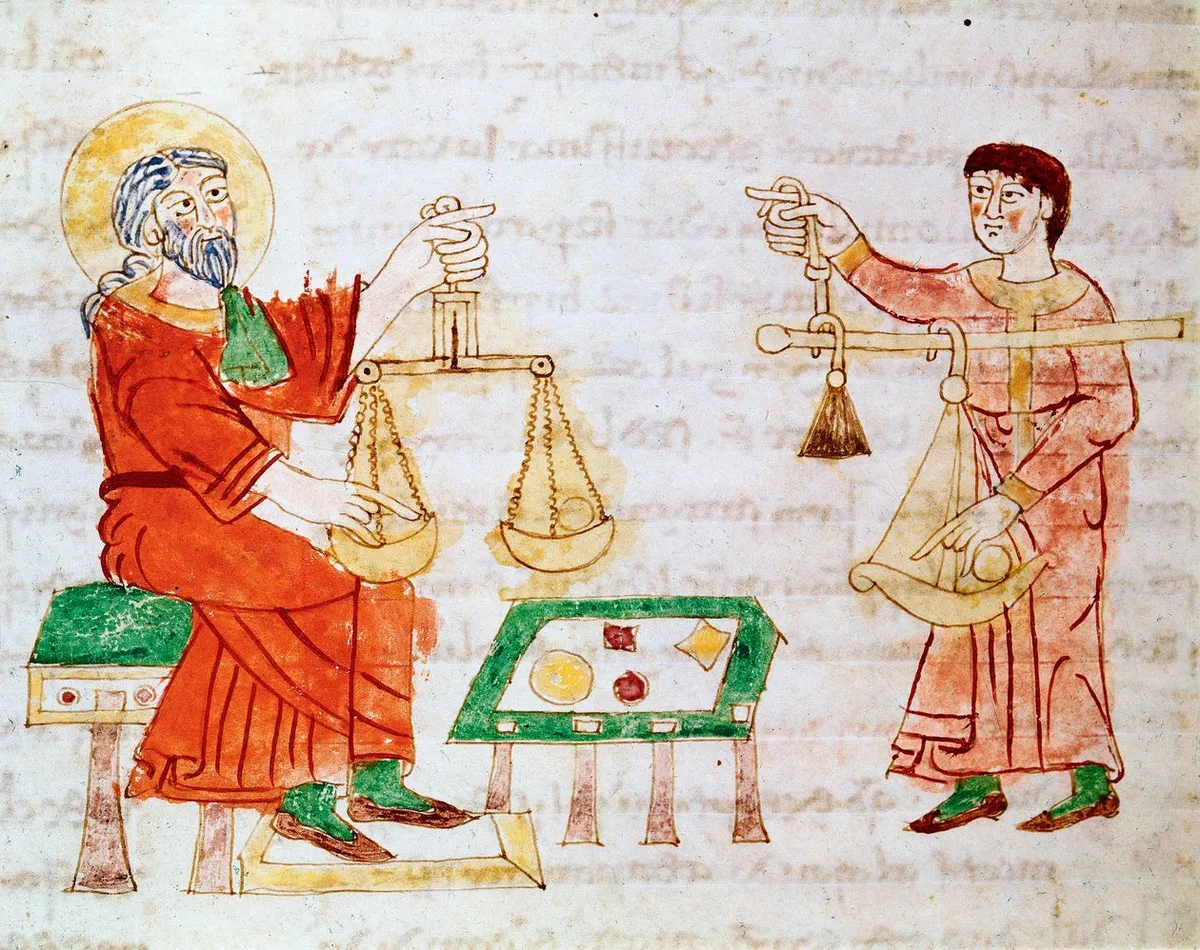
There is something wonderfully familiar about the scene in this image, from an early eleventh-century manuscript.
These aren't people simply exchanging goods without thought. They are weighing what is being sold and negotiating over it.
Weights and measures were an important part of medieval trade. The precise systems varied between places and periods, which could make buying and selling rather more complicated than simply looking at a price tag.
And, of course, there was always the possibility that someone might try to give you slightly less than you had paid for.
Some things, apparently, never change.
You couldn't just order it online
One of the biggest differences between medieval shopping and our own is that getting goods from somewhere else could be a considerable undertaking.
Goods could travel by road, river and sea, with merchants transporting products between towns and regions.
But medieval roads weren't exactly designed for next-day delivery.
A cart could break down. An animal could become ill. Bad weather could make travelling difficult. Roads could be poor, and journeys could take considerable time.
So if the merchant told you your goods were coming from somewhere else, you might have to be rather patient.
Very patient.
There was no:
“Where's my order?”
followed by a helpful tracking map showing a tiny van moving towards your house.
There was simply:
“The merchant has gone to York.”
“When will he return?”
“When he returns.”
Not everything came from a market stall
Medieval towns were full of specialist craftspeople.
If you needed something made rather than simply picked up and taken home, you might deal with a person whose entire livelihood depended on producing that particular type of item.
Shoes, clothing, metalwork, pottery and countless other goods were produced by skilled craftspeople.
This meant that shopping could sometimes be more like commissioning something than buying an item straight off a shelf.
You might explain what you wanted, agree a price and wait for it to be made.
So:
Modern shopping:
Add to basket → Pay → Dispatch.
Medieval shopping:
Find craftsman → Explain requirements → Negotiate → Wait.
And possibly:
“No, that's not quite what I meant.”
Then there were the fairs
Markets weren't the only places where medieval trade happened.
Fairs could attract merchants and customers from much further afield, bringing together a wider variety of goods and people than you might find at an ordinary local market.
For someone living in a small settlement, a major fair could provide an opportunity to encounter goods and traders they wouldn't normally see.
It was, in some respects, the medieval equivalent of going somewhere considerably more exciting to do your shopping.
Just with fewer car parks.
So was medieval shopping really that different?
In some ways, yes.
There were no supermarkets, online marketplaces, contactless payments or delivery notifications. Prices, weights and measures could vary, goods might need to be commissioned, and transporting something from another place could take days or weeks.
But the basic idea was remarkably familiar.
People needed things.
People made things.
People sold things.
And other people wanted to buy them.
The medieval marketplace was a place where all of those things came together.
The biggest difference was probably the delivery service.
There was no Amazon Prime.
No tracking number.
No “Sorry we missed you” card.
Just a merchant, a cart, a few pack animals and the vague promise that your goods would eventually turn up.
Probably.